


19 min read
Buy a flat or a house in Portugal and you will soon hear two contradictory statements: “home insurance is compulsory here” and “the law does not make you insure anything”. Both are only half right. Whether you must take out insurance depends on how your property is legally divided, whether a bank is financing it and whether you let it to holiday guests. Your nationality and where you live make no difference: the rules apply to British owners just as they do to Portuguese ones.
This guide sorts the cases by the law as it stands: the Civil Code (Código Civil) for flats in a shared building, the mortgage credit law for buyers with a loan, the holiday rental law (alojamento local) and the insurance contract law. A separate section explains what the compulsory catastrophe insurance announced in April 2026 is about and how far it has got.
- Flat in a shared building: In buildings divided into separately owned units (condomínio), fire insurance is compulsory, for each individual flat as well as for the common parts (Article 1429 Código Civil).
- Detached house outside a condomínio, without a mortgage: There is currently no legal obligation to insure it.
- Buying with a mortgage: The bank may require suitable insurance, but it must accept a policy from another insurer if it offers equivalent cover.
- Holiday letting: Anyone running an alojamento local needs liability insurance of at least 75,000 euros per claim, and in a condomínio also fire cover for the unit.
- Compulsory catastrophe insurance: Announced in April 2026, but as of October 2026 neither a law nor a published draft bill.
- The legal minimum is not enough: The compulsory fire cover pays neither for water damage nor storm, burglary or liability, and fire caused by an earthquake is excluded under common policy terms.
The short answer: when insurance is compulsory
There is no general obligation to insure every residential building in Portugal. There are, however, three situations in which insurance is required by law or by your lender. The table shows which one applies to you.
| Your situation | Compulsory? | What exactly | Legal basis |
|---|---|---|---|
| Flat in a building with an owners’ association | yes | fire insurance for your own flat and the common parts, updated every year | Art. 1429 Código Civil, Art. 5 Decreto-Lei 268/94 |
| Purchase with a mortgage | by contract | the insurance the bank requires in the loan agreement, usually for the building plus life cover | Art. 11 Decreto-Lei 74-A/2017 |
| Holiday letting (alojamento local) | yes | liability cover from 75,000 euros per claim; in a condomínio also fire cover for the unit | Art. 13-A Decreto-Lei 128/2014 |
| Detached house outside a condomínio, paid off, own use | no | no legal obligation | no rule |
| Flat let long-term | only as above | fire insurance for flats in a condomínio; the law sets no separate obligation for landlord or tenant | Art. 1429 Código Civil |
The difference between law and contract matters. Fire insurance in a condomínio and liability cover for holiday lets are required by law. Insurance for a mortgage is a condition set by the bank and lasts as long as the loan agreement.
Flats: fire insurance under Article 1429
For buildings divided into separately owned units (propriedade horizontal), Article 1429 of the Código Civil provides: “É obrigatório o seguro contra o risco de incêndio do edifício, quer quanto às frações autónomas, quer relativamente às partes comuns.” In English: fire insurance of the building is compulsory, both for the individual units and for the common parts.
So the obligation does not only cover the stairwell, roof and façade. Your own flat must be insured against fire too. Many owners meet the part for their unit with their own home insurance, because a multi-risk home policy (seguro multirriscos habitação) almost always includes fire. How the building policy of the owners’ association and your own policy fit together is explained on our page Condominium Insurance in Portugal.
Who takes it out and what happens if nobody does
Under Article 1429 paragraph 2, the owners themselves must take out the insurance. The owners’ meeting decides by when and for what sum. If an owner has not taken it out within that deadline, the building administrator (administrador) must do so on their behalf and may recover the premium from them. Checking that the fire insurance exists and proposing the sum insured to the meeting is expressly one of the administrator’s statutory duties (Article 1436 Código Civil).
The law sets no fine for owners without fire insurance. The consequence is still real: the administrator insures you at your expense, without you choosing the insurer or the terms. And if a fire breaks out in your flat while no policy is in place, you bear the damage to your flat yourself. Fire insurance does not pay for damage that a fire you caused does to neighbouring flats either; that needs liability cover, as a multi-risk policy normally includes.
The annual update
Under Article 5 of Decreto-Lei 268/94, fire insurance in a condomínio must be updated every year. The owners’ meeting decides the amount. If it decides nothing, the administrator updates the sum in line with the index the insurance regulator publishes every quarter. Something similar applies to your own home insurance: under Article 135 of the insurance contract law (Decreto-Lei 72/2008), the insured value of a residential property is updated automatically according to that index, unless the contract says otherwise. The insurer must tell you about this and about the insured value when the policy starts and at each renewal; if it does not, it cannot hold underinsurance against you to that extent (Article 135(3)).
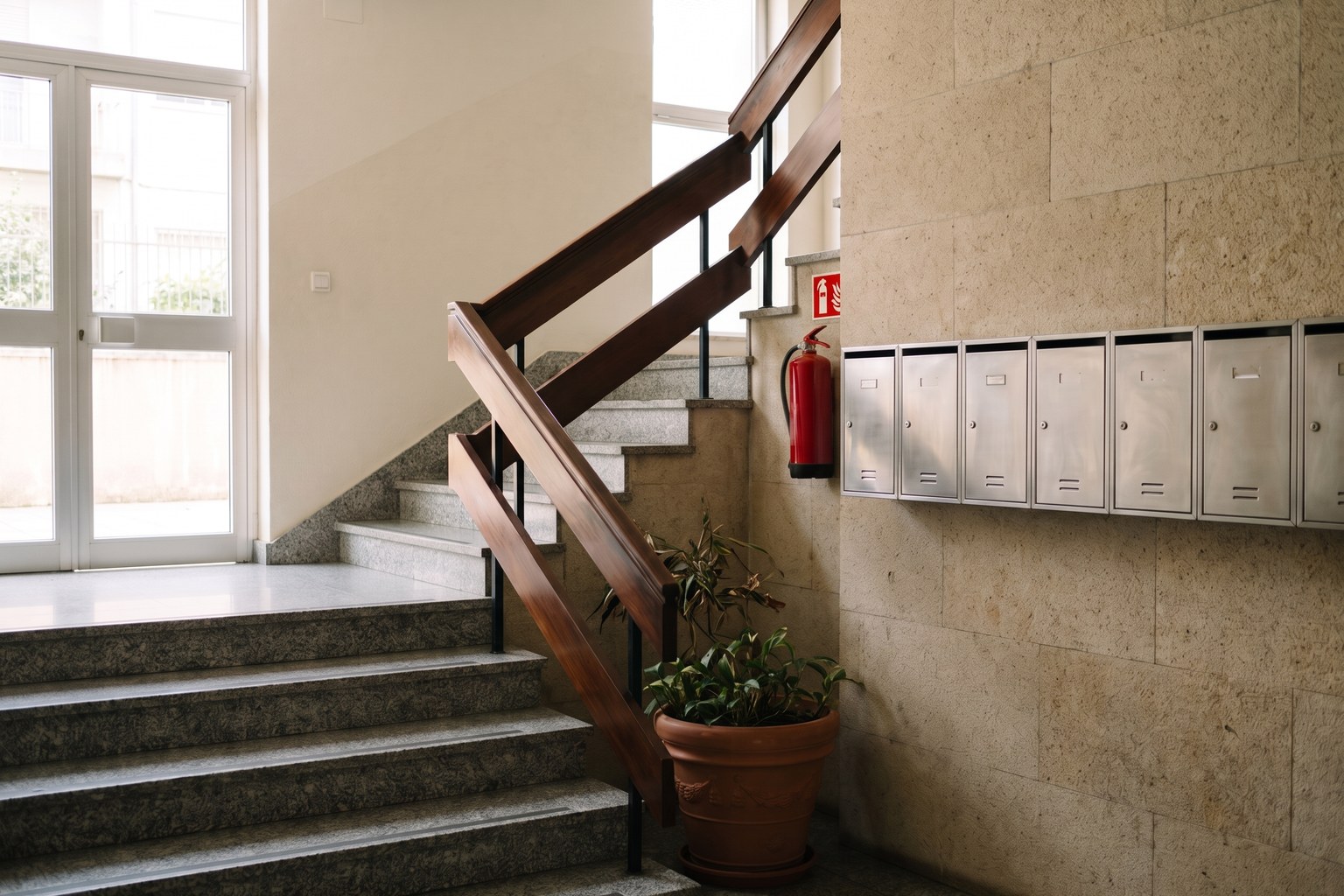
Whether the association has a building policy for the whole block or only insures the common parts is recorded in the minutes of the owners’ meeting (ata) and in the policy held by the administrator. Ask for both before you take out your own home insurance. That way no part is insured twice and no part is left uninsured.
Buying with a mortgage: what the bank may require
When a bank finances the purchase, it almost always requires insurance. That is allowed, but regulated. Under Article 11 of Decreto-Lei 74-A/2017, the bank may not, as a rule, make the loan conditional on you buying other products from it. Insurance is an exception: the bank may require you to take out insurance suited to the loan. It must then accept a policy from another provider if that policy offers cover equivalent to the one the bank proposes.
In practice banks ask for two things: insurance for the building, usually a multi-risk policy, and life cover for the loan amount. For life cover, Law No. 14/2026 of 27 April 2026 added that the bank may only require cover for death; cover for disability or incapacity may be offered, for example in exchange for a lower interest margin, but not made a condition. You can also replace the life cover the bank requires with another security provided for by law, such as a mortgage on another property or a personal guarantee (Article 11(8)).
What the bank may doArt. 11
Require insurance suited to the loan, for instance for the building and as life cover, and offer a lower interest margin if you take out products with it. It must show that saving openly in the annual percentage rate.
What the bank may not doArt. 11
Insist that you take out the insurance with the bank or its partner when your own policy gives equivalent cover. For life cover, it can only require cover for death, and you may replace it with another legal security.
Always do the sums before switching: a discount on the interest margin can be worth more than the saving on the premium, or the other way round.
Suppose your bank proposes a building policy with a sum insured of 250,000 euros. If you bring a quote from another insurer with the same sum, the same perils and the bank named as beneficiary in the event of a claim, the bank assesses whether it is equivalent. If it refuses, ask for the reason in writing.
Detached house without a mortgage, outside a condomínio: no obligation
A detached house (moradia) that you own outright, that is not financed and not let to holiday guests does not have to be insured under current law. Article 1429 only applies to buildings with an owners’ association, and no other law requires buildings or contents insurance for homes.
It can be different if your house is part of a development with shared areas, such as a townhouse or a villa in a gated development (condomínio fechado) with a shared pool and gardens. If the development is registered as propriedade horizontal, the fire insurance obligation under Article 1429 applies to your house too. The land registry certificate (certidão permanente) and the development’s rules will tell you.
For a detached house, that also holds once the mortgage is paid off: the obligation under the loan agreement ends, and no legal one remains. If you cancel your policy after the last instalment, you are left without cover against fire, storm or a burst pipe. For houses in the Algarve, on the Silver Coast or inland, where wildfire and heavy rain are part of the risk, that is a big step. What home insurance covers here is set out on our page Home Insurance in Portugal.
Holiday letting and long-term letting
Alojamento local: liability cover is compulsory
Anyone letting a flat or house to holiday guests as an alojamento local must take out and maintain liability insurance under Article 13-A of Decreto-Lei 128/2014 as amended in 2024. It must cover financial and non-financial loss suffered by guests and third parties as a result of the letting, with at least 75,000 euros per claim. If the unit is in a building with an owners’ association, the operator must also prove insurance for fire damage that starts in or spreads from the unit.
The municipality can ask for proof at any time, which must then be provided within three days. Without the insurance, the registration can be cancelled. A standard home policy is often not enough, because its liability section usually excludes damage arising from commercial letting. More on this in our guide Holiday Home Insurance in Portugal.
Long-term letting
For a flat let on a normal tenancy, the law sets no separate insurance obligation, neither for the landlord nor for the tenant. If the flat is in a condomínio, the owner remains responsible for fire insurance under Article 1429. Whether the tenancy agreement requires insurance is a matter for the agreement itself.
The announced compulsory catastrophe insurance
On 28 April 2026 the government presented its Transformation, Recovery and Resilience Plan (Plano de Transformação, Recuperação e Resiliência, PTRR; government document). One measure in it: a review of the insurance rules for catastrophes, a fund for natural catastrophes and earthquakes, and compulsory insurance against catastrophes and earthquakes for homes, backed by a solidarity mechanism so that low-income households can afford the premium. The plan classifies the measure as medium-term and gives no date.
As of the end of October 2026, it has not become law, and no draft bill has been published. In May 2026 the economy minister, Manuel Castro Almeida, expected a decree-law to be in force in 2027; the insurance regulator says it handed the government the foundations for such a system in March 2026 and argued again for compulsory cover before parliament in October 2026.
What has been announced is an obligation covering catastrophes and earthquakes, not a general home insurance obligation with a fixed scope. The minimum cover, who pays and when it applies have not been decided. Until then, the current law described in this guide applies. Earthquake cover is today an optional add-on to your home insurance.
Why compulsory fire cover is not enough
Under the insurance contract law, fire insurance covers damage caused by fire, by firefighting, by smoke, heat and an explosion resulting from the fire and, unless agreed otherwise, lightning and explosion without fire (Articles 149 and 150 Decreto-Lei 72/2008). That is the legal minimum. The most common damage to homes in Portugal lies elsewhere.
Compulsory fire cover
the legal minimum
- fire, lightning, explosion
- damage from firefighting water and smoke
- not covered: water, storm, burglary, liability and, under common policy terms, fire caused by an earthquake
Multi-risk home insurance
seguro multirriscos habitação
- in addition escape of water, storm, flood, burglary and glass breakage, depending on the policy
- liability as owner, contents cover if wanted
- earthquake available as an add-on
What a storm can cost on the roof and what insurance pays is described in our guide Storm Damage in Portugal. Why an earthquake is usually not covered without the add-on, nor the fire that follows it, is explained in Earthquake Insurance in Portugal.
The right sum insured
A policy with a sum insured that is too low pays only part of a claim. Article 134 of the insurance contract law provides that if the sum insured is below the value of the insured property, the insurer is only liable in the corresponding proportion, unless agreed otherwise. If you insure your house for 150,000 euros although rebuilding it would cost 300,000 euros, a loss of 40,000 euros brings you only 20,000 euros.
What counts is the value agreed in the contract. Article 131 expressly allows a rebuilding value (valor de reconstrução) to be set. For a residential building that is usually the right measure, not the purchase price and not the market value: the purchase price includes the plot and the location, which a fire does not destroy. Conversely, rebuilding an older house with natural stone and timber ceilings can cost more than the market would pay for it.
Floor area times regional building costs per square metre for a similar type of construction, plus demolition, design and permits. For houses with a pool, outbuildings or solar panels, value these separately. Your insurer or broker will check the sum with you and confirm whether it rises with the index under Article 135. Our guide How to calculate the reconstruction cost of a property in Portugal walks through the calculation with square-metre values and the simulator.
Five common mistakes with compulsory cover
Frequently asked questions
Answers to common questions about compulsory insurance for houses and flats in Portugal.
Is home insurance mandatory in Portugal?
Not in general. Fire insurance is compulsory for flats and common parts in buildings with an owners’ association (Article 1429 Código Civil), and liability cover is compulsory for holiday letting as an alojamento local. With a mortgage, the bank requires insurance by contract. For a detached house outside a condomínio that is paid off and lived in by the owner, there is no obligation.
Do I have to insure my own flat as an apartment owner?
Against fire, yes. The obligation under Article 1429 applies to every individual flat and to the common parts. Whether the association’s building policy already includes your flat is stated in the policy and in the minutes of the owners’ meeting. Otherwise you meet the obligation with your own home insurance.
What happens if I have no fire insurance in a condomínio?
Once the deadline set by the owners’ meeting has passed, the administrator must take out the insurance on your behalf and may recover the premium from you. The law sets no fine. If a fire occurs while no policy is in place, you bear the loss yourself.
Do I have to take out insurance with my bank?
No. The bank may require insurance suited to the loan, but under Article 11 Decreto-Lei 74-A/2017 it must accept a policy from another insurer if it offers equivalent cover. If the bank offers an interest discount for its own policy, compare the total cost.
Which life insurance can the bank require for a mortgage?
Since Law No. 14/2026 of 27 April 2026, the bank may only require cover for death. It may offer cover for disability or incapacity, for example in exchange for a lower interest margin, but not make it a condition. You can replace the life cover itself with another legal security, such as a mortgage on another property or a personal guarantee.
Do I need special insurance for a holiday home I let out?
Yes, if you let it to holiday guests as an alojamento local. Liability insurance of at least 75,000 euros per claim is then compulsory, and in a condomínio also fire cover for the unit. Without the insurance, the municipality can cancel the registration.
Will home insurance soon be compulsory for everyone in Portugal?
In April 2026 the government announced compulsory insurance against catastrophes and earthquakes for homes, with a fund and support for low-income households. As of October 2026 there is neither a law nor a published draft bill; in May 2026 the economy minister, Manuel Castro Almeida, expected it to come into force in 2027. Scope and start date have not been decided.
Is earthquake cover part of the compulsory fire insurance?
No. In a condomínio the law only requires fire insurance, and fire caused by an earthquake is excluded from it under common policy terms. Earthquake cover is an optional add-on to home insurance.
Do tenants in Portugal need insurance?
The law does not require tenants to have insurance. The tenancy agreement may require it. Contents and liability insurance makes sense, because the tenant is liable for damage they negligently cause in the flat or to neighbours.
What sum should I insure my house for?
The rebuilding value, meaning the cost of building it again, not the purchase price. If the sum is too low, under Article 134 Decreto-Lei 72/2008 the insurer only pays in the proportion that the sum insured bears to the actual value.
Our advice as an independent broker
First check which case applies to you: a flat in a condomínio, a mortgage, holiday letting or a detached house without a loan. That tells you what is compulsory. Then decide what makes sense, and in almost every case that is more than the obligation: a multi-risk policy with water, storm and liability cover, a rebuilding value that is right and, in regions with seismic risk, the earthquake add-on.
As an independent insurance broker we compare home insurance in Portugal from several insurers, check whether a policy meets your bank’s requirements and clarify with the administrator what your association’s building policy already covers, in English. For Lisbon, Porto, Cascais and the Algarve you will find the local details on our pages Lisbon Home Insurance, Porto Home Insurance and Cascais/Estoril Home Insurance, and for the Algarve Insurance in Loulé and Quinta do Lago Home Insurance.
Request a quote for your home insurance
Last updated: 30 October 2026. This article reflects the information available on that date and does not replace individual legal or insurance advice. The terms of your contract apply. Sources reviewed: Articles 1429 and 1436 of the Código Civil, Article 5 of Decreto-Lei 268/94, Article 11 of Decreto-Lei 74-A/2017 as amended by Law No. 14/2026, Article 13-A of Decreto-Lei 128/2014 as amended by Decreto-Lei 76/2024, Articles 131, 134, 135, 149 and 150 of Decreto-Lei 72/2008 and the government’s PTRR document of 28 April 2026.