


21 min read
A burst pipe under the sink, water seeping through the ceiling into the flat below, a break-in while you spend the winter in the UK: when something goes wrong with your property in Portugal, what counts is less how good your home insurance looks on paper and more what you do in the first few days. Report too late, clear away the evidence or carry out repairs without agreement, and the insurer may reduce the payout even though the damage is covered.
This guide takes you step by step through a home insurance claim in Portugal: what to do straight away, when and how to report the damage, which evidence the insurer will want, how long it may take to decide and what you can do if it refuses or offers too little. It is based on the Portuguese Insurance Contract Act (Decreto-Lei 72/2008), the April 2025 recommendations of the insurance supervisor ASF on claims handling in home insurance and the policy conditions of Fidelidade and Mapfre.
- Limit the damage: you must do what you reasonably can to keep the loss small. The insurer reimburses reasonable costs for this, even if the measure did not work (Articles 126 and 127).
- Preserve the evidence: do not throw away damaged parts or carry out permanent repairs before the insurer has agreed or inspected the damage.
- Report within eight days: that is the legal deadline if your policy sets no other; Fidelidade and Mapfre require notice in writing. Reporting late does not automatically cost you the claim.
- Burglary and theft: report it to the PSP or GNR straight away and send the police report to your insurer.
- The insurer’s timescales: the ASF recommends a first contact within four working days and a decision within 25 working days (building) or 40 working days (contents). Payment falls due 30 days after the insurer has finished its investigation.
- If the claim is refused: ask for written reasons, object in writing and, if necessary, take the dispute to the CIMPAS mediation and arbitration centre.
The first hours: limit the damage and keep the evidence
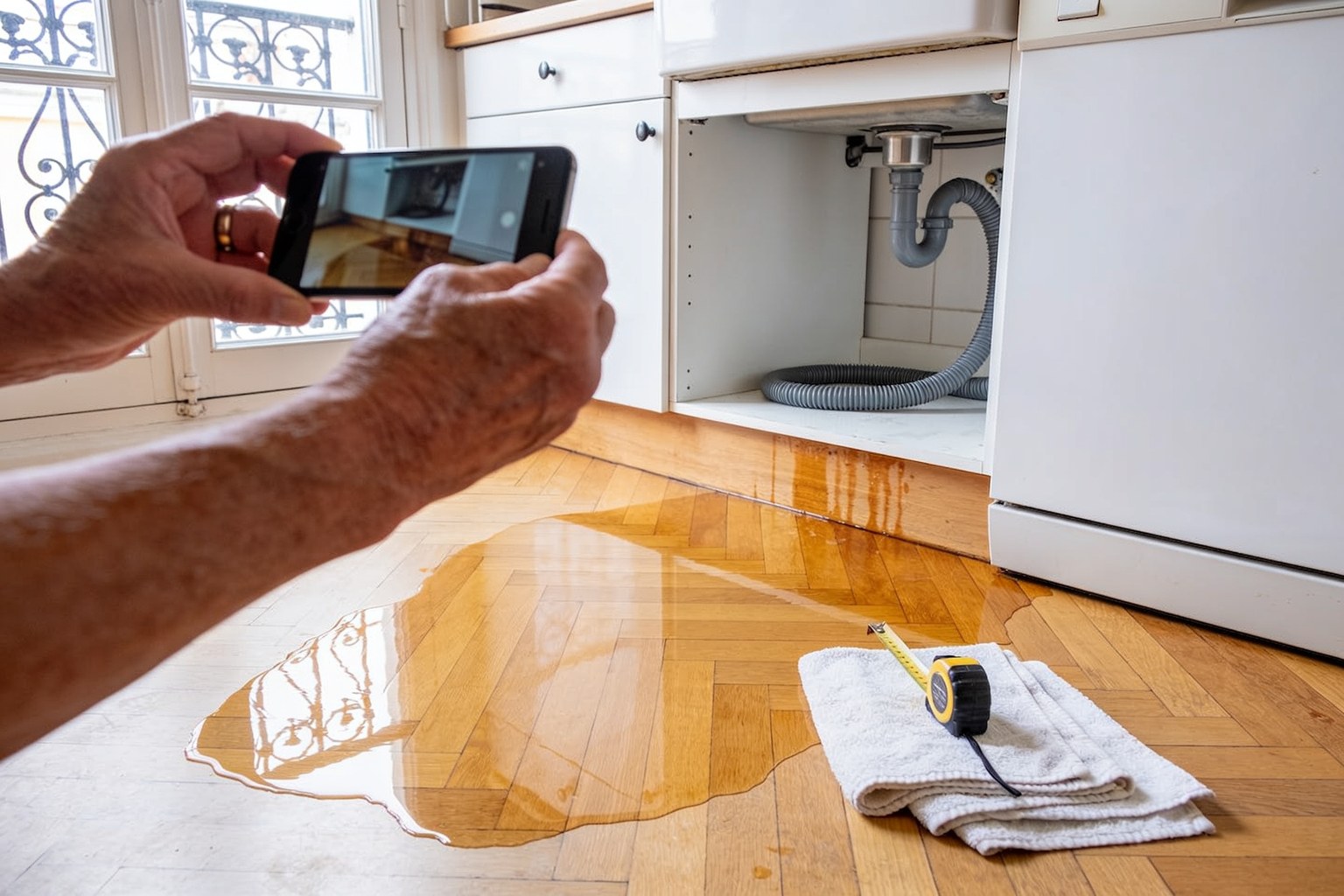
After an incident the law first asks one thing of you: you must use “os meios ao seu alcance para prevenir ou limitar os danos”, the means within your reach to prevent or limit the damage (Article 126 Decreto-Lei 72/2008). In practice: first stop the source by turning off the water at the mains and switching off the electricity in the affected room. Then take photos, and only after that temporarily close a broken window and move furniture out of the water.
You do not bear these costs alone. Under Article 127 the insurer pays the expenses of such measures as long as they are reasonable and proportionate, even if they turn out to be ineffective. If the damage is covered, you can ask for these costs to be paid before the claim itself is settled, unless the circumstances prevent it. They are, however, deducted from the sum insured, unless the insurer specifically instructed the measure or your policy covers it separately.
Emergency repairs yes, permanent repairs no
There is an important difference between limiting damage and repairing it. The conditions of Fidelidade (Clause 23 of Fidelidade Casa Mais, September 2026 edition) and Mapfre (Article 31 of its home insurance conditions, October 2024 edition) both require you not to remove or alter traces of the incident without the insurer’s agreement and to keep damaged items, as far as is reasonable. In Article 32 Mapfre expressly lists provisional repairs among the costs it reimburses.
A tarpaulin on the roof, a pipe that the plumber seals, a board over a forced window: that is limiting the damage. A new kitchen, new parquet flooring or a completely replaced pipe system is a repair. Leave that until the insurer has agreed or inspected the damage. Photograph everything before you clear up or change anything, and keep faulty parts such as the split hose or the broken lock.
For burglary, theft or robbery the policy conditions require a report to the police, the PSP in towns or the GNR in rural areas. Fidelidade says “logo que possível” (as soon as possible), Mapfre’s special theft conditions “imediatamente após o seu conhecimento” (immediately after you find out). A copy of the report goes to the insurer. If stolen items are found later, you must report that too.
Reporting the claim: deadline, form, content
Article 100 of the Insurance Contract Act says the damage must be reported “no prazo fixado no contrato ou, na falta deste, nos oito dias imediatos àquele em que tenha conhecimento”: within the period in your policy, or otherwise within eight days of becoming aware of it. Fidelidade and Mapfre require notice “por escrito”, in writing, as quickly as possible and no later than eight days after the incident or the day you became aware of it. An email, the insurer’s claim form or a report made through your broker all meet this requirement.
Under Article 100(2) the report must explain when and how the damage occurred, what may have caused it and what its consequences are. If the insurer later asks for further information, you must provide it (paragraph 3).
| What the report should contain | Example: water damage |
|---|---|
| Date, time, place | Discovered on 12 January at around 8 am, kitchen of the second-floor flat |
| What happened | Water under the sink, parquet swollen, stain on the ceiling of the flat below |
| Possible cause | Dishwasher inlet hose leaking |
| Consequences | Base cabinet, about 8 m² of parquet, ceiling stain at the neighbour’s |
| What you have already done | Water turned off, hose removed and kept, plumber booked to seal the leak |
| Others involved | Neighbour on the first floor, condominium administrator informed |
What happens if you miss the eight days
The eight-day deadline does not extinguish your claim. Article 101 only allows the policy to reduce the payout by the loss that the late or incomplete report has caused the insurer. You can lose the claim entirely only if you acted deliberately and the insurer suffered significant harm as a result. There is no reduction if the insurer learned of the damage by other means within the deadline, or if you can show that you could not reasonably have reported it earlier, for example because you were in hospital after an accident. Fidelidade and Mapfre include exactly this rule in their conditions. Important if you do not live in Portugal: under the Act the eight days only start once you become aware of the damage.
That is no reason to wait. Water damage grows every day, and that additional damage is precisely the loss the insurer can hold against you after a late report. How this works after a storm is explained in our guide to storm damage in Portugal.
More than one policy: declare them all
If the same damage is covered by more than one insurer, for example by your own home insurance and the building policy of the condominium, you must tell all insurers when you report it (Article 133). Concealing it fraudulently releases the insurers from paying. You may then choose which insurer pays; the insurers settle the share between themselves. How the building policy and your own policy fit together in a condomínio is explained on our page on condominium insurance.
The evidence your insurer will want
Losses you can prove are paid more easily. That applies above all to contents, where the insurer cannot see the value of individual items for itself.
- Photos and videos of the damage before you clear up, with an overview and close-ups.
- Damaged parts such as the burst piece of pipe, the forced lock, the remains of a burnt appliance.
- Invoices, receipts or photos of the damaged or stolen items, including from before the incident.
- The police report for burglary, theft or robbery.
- Repair quotes and invoices for emergency measures.
- If neighbours are involved, their contact details and insurer, and for water damage between two flats the joint water damage declaration DADA (below).
Once a year, walk through your house or flat with your smartphone and film every room with the cupboards open. Store the video together with receipts for expensive appliances, jewellery and art somewhere outside the house, such as a cloud folder. After a fire or burglary this recording is often the only proof of what was there.
The insurer may not demand any document it likes. Under the Portuguese law on unfair commercial practices (Article 12(d) Decreto-Lei 57/2008), to which the ASF expressly refers in its recommendations, it is unfair to require policyholders to produce documents that cannot reasonably be considered relevant to the claim, or to systematically leave correspondence unanswered in order to discourage them from exercising their rights.
Inspection and payment: which timescales apply
After your report the insurer will send a loss adjuster (perito) for larger claims. The inspection (peritagem) establishes whether an insured event has occurred, what caused it and how large the loss is. Be present at the appointment or have someone represent you, and have photos, damaged parts and receipts ready.
What the law and the policy conditions say
The insurer must pay once the occurrence, cause, circumstances and consequences of the damage have been confirmed (Article 102). Payment falls due 30 days after that investigation has been completed (Article 104), not 30 days after the incident.
The Fidelidade and Mapfre conditions add that investigations and inspections must be carried out “com a adequada prontidão e diligência”, promptly and diligently; an insurer that fails to do so is liable for the resulting loss. Under both sets of conditions the insurer owes interest at the statutory rate if, 30 days after completing its investigation, it has neither paid nor authorised the repair without justified reason. Both sets of conditions provide for interim payments where appropriate.
What the insurance supervisor recommends
Because the law sets no maximum timescales for the individual steps in home insurance, the insurance supervisor ASF published its own Recommendations (Recomendações No. 2/2025) on claims handling in home insurance on 8 April 2025. According to the ASF, one reason was that half of the complaints it handles concern claims, and slow handling is the most common reason for complaints about claim settlement. From receipt of the report, the insurer should:
| Step | Recommended maximum |
|---|---|
| First contact with you, appointment for the inspection or information on the next steps | 4 working days |
| Decision on cover and the amount accepted, damage to the building | 25 working days |
| Decision, damage to contents | 40 working days |
| Decision, damage to building and contents | 40 working days |
The decision deadlines can be up to twice as long: when an exceptionally high number of claims arrive at once, for example after a storm, when the claim is made under a condominium building policy, and for fire and earthquake claims. They can be suspended while there is a well-founded suspicion of fraud. If the insurer refuses all or part of the claim, it should give its reasons in writing and state how you can challenge the decision. While the claim is in progress, it should keep you regularly informed.
The ASF timescales are recommendations. Insurers tell the supervisor whether they follow them and should publish their average handling times on their website. They are not binding on the insurer. They are, however, a good benchmark when you chase the insurer or complain: if you have heard nothing after six weeks, you can point to the supervisor’s recommendation.
Water damage: what decides the claim
Water damage in Portuguese houses and flats has many causes: leaking pipes in older buildings, washing machine and dishwasher hoses, drains, damp coming from a neighbour. Three questions decide whether you are paid.
Sudden or gradual?
Multi-risk home insurance (seguro multirriscos habitação) pays for a sudden burst pipe, not for slow deterioration. In its cover for tracing and repairing leaks, Fidelidade expressly excludes damage caused by a lack of maintenance of the water and drainage pipes where there are clear signs of deterioration, such as rust, leaks or stains. A stain that has been growing on the ceiling for months is therefore a risk to the claim. Report damp as soon as you notice it.
Who pays to find the leak?
Finding a hidden leak often means opening up a wall or floor. Many policies include separate cover for this (pesquisa e reparação de rotura); at Fidelidade up to the amount stated in the policy schedule. Not covered there are the repair or replacement of the appliances the water came from, such as taps, water heaters or radiators, and the extra water consumption caused by the leak. Check your policy to see whether and up to what amount leak tracing is covered before you instruct a tradesman.
Is a neighbour involved?
When water runs from one flat into another, Portuguese insurers use a simplified procedure: the joint water damage declaration (Declaração Amigável de Danos por Água, DADA). Both parties complete the form and sign it together, and each submits a signed copy to their own insurer. When the procedure applies and how to fill in the form is explained in our article on the DADA friendly declaration of water damage.
Two things you should not do: admit fault to your neighbour or promise to pay for their damage yourself. Both sets of conditions forbid accepting liability towards third parties without the insurer’s consent. Describe what happened and leave the question of liability to the insurers. If the water comes from common parts such as the main riser or the roof, the condominium administrator is your contact. The condominium’s policy then applies if it includes water damage; only fire cover is compulsory there.
Why insurers reduce or refuse claims
Behind a refusal or reduction there is often a policy condition nobody read when taking out the cover. Typical reasons:
Lack of maintenanceExclusion
Damage from wear and tear, old pipes, a roof that has leaked for years or damp that was known about for a long time is not a sudden event. For older houses and second homes that are rarely used, this is a typical point of dispute.
UnderinsuranceArt. 134
If the sum insured is below the actual value, the insurer pays only in proportion, unless the policy says otherwise. With a sum insured of €150,000 and a rebuild value of €300,000, a €40,000 loss is settled at €20,000.
Empty propertyConditions
At Fidelidade the payout is reduced proportionally if the house is unoccupied and an alarm or security system declared in the proposal was not switched on. Other insurers handle this differently; your policy tells you how.
Evidence removed, reported lateArt. 101
Making permanent repairs or throwing away parts before the inspection makes the claim harder to prove. The payout can be reduced by the loss this causes the insurer.
False information can be costly. Both sets of conditions prohibit exaggerating the loss in bad faith, listing items that were not affected or submitting false documents; anyone who does so is liable to the insurer for the resulting loss. Stick to what you can prove, and write “estimated” where you are estimating.
Whether your sum insured is right can be checked before anything happens. How to work out the rebuild value is shown in our guide How to calculate the reconstruction cost of a property in Portugal; which insurance is actually compulsory in your situation is set out in our guide Is home insurance mandatory in Portugal?
If you disagree with the decision
If the insurer refuses the claim or offers significantly less than the repair costs, proceed in this order.
- Ask for written reasons. Ask which clause of the conditions the decision is based on and how the amount was calculated. Under the ASF recommendation, a refusal should be reasoned in writing anyway and state the options open to you.
- Object in writing. Reply with your view and enclose photos, a second quote or your own expert report if the amount is in dispute. Every insurer has a complaints department; your broker knows the right route and can handle the complaint for you.
- Mediation at CIMPAS. The Centro de Informação, Mediação, Provedoria e Arbitragem de Seguros (CIMPAS) is the body that handles disputes arising from insurance contracts, expressly including multi-risk and fire insurance. A fee is only charged once the case moves to mediation and arbitration: 3% of the amount in dispute, at least €70 and at most €700; if the parties reach agreement at the mediation stage, each side gets 25% of it back.
- Supervisor and courts. The ASF supervises the insurers. A final decision on an individual case is made by an arbitration tribunal or a court.
What each body does and when it is worth turning to it is described in our guide to storm damage in Portugal, in the section on what to do if the insurer does not pay. All the ways to report a claim through us are listed on our page Claims in Portugal.
Five mistakes to avoid
Frequently asked questions
Answers to common questions about home insurance claims in Portugal.
How long do I have to report damage to my home in Portugal?
The deadline is set in your policy. If it sets none, Article 100 of Decreto-Lei 72/2008 gives you eight days from the day you became aware of the damage. Major insurers such as Fidelidade and Mapfre require written notice as quickly as possible and within eight days at the latest.
Do I lose my claim if I report it late?
Not automatically. The policy may only reduce the payout by the loss the delay caused the insurer. You lose the claim entirely only if you acted deliberately and the insurer suffered significant harm. There is no reduction if the insurer learned of the damage in time by other means or you could not reasonably have reported it earlier.
Can I carry out repairs before the inspection?
Emergency measures yes, permanent repairs no. You must limit the damage, for example by sealing a leak or temporarily closing a window, and the insurer reimburses reasonable costs for this. You may not remove traces of the incident without its consent, however, and you should keep damaged parts.
Do I have to report a burglary to the police?
Yes. The conditions of major home insurers such as Fidelidade and Mapfre require a report to the PSP or GNR for theft, burglary and robbery, as soon as possible or immediately after you find out, and a copy for the insurer. If items are found later, you must report that too.
How long can the insurer take to decide on my claim?
There is no law setting maximum timescales for home insurance. Since April 2025 the insurance supervisor ASF has recommended a first contact within four working days and a decision within 25 working days for building damage and 40 working days for contents. For fire, earthquake, claims under a condominium building policy and very large numbers of simultaneous claims the decision timescales can double.
When does the insurer have to pay?
Under Article 104 of Decreto-Lei 72/2008 payment falls due 30 days after the insurer has completed its investigation. If it still does not pay without justified reason, the Fidelidade and Mapfre conditions oblige it to pay interest at the statutory rate.
What is the DADA?
The Declaração Amigável de Danos por Água is a joint declaration for water damage between two flats. Both parties complete and sign the form, and each submits a copy to their own insurer. This speeds up settlement between the insurers.
Does home insurance pay for water damage from old pipes?
A sudden burst pipe usually yes, gradual damage from wear and tear often not. Fidelidade, for example, excludes from its leak-tracing cover damage caused by a lack of maintenance where there were clear signs such as rust, leaks or stains. Report damp as soon as you notice it.
What can I do if my insurer refuses the claim?
Ask for the refusal to be explained in writing with the clause and calculation, object in writing with photos and a second quote, and use the insurer’s complaints department. If the dispute continues, you can turn to the CIMPAS mediation and arbitration centre, which also handles home insurance.
Do I have to declare other insurance policies?
Yes. If the same damage is also covered by another policy, such as the condominium’s building insurance, Article 133 of Decreto-Lei 72/2008 requires you to tell all insurers when you report it. Concealing it fraudulently releases the insurers from paying.
Our advice as an independent broker
The first few days decide a claim: limit the damage, photograph everything, keep faulty parts, report in writing, and go to the police after a break-in. After that it is about evidence and patience, and if the insurer’s answer is wrong, a written objection with reasons.
As your broker we report the claim to the insurer for you, accompany the inspection, check the offer against your policy conditions and handle the complaint if necessary, while keeping you informed in English. You can send us your claim directly via our page File a house insurance claim in Portugal. Better still is a policy that is right before anything happens: with the correct sum insured, water damage and leak tracing, theft and liability cover. What good home insurance in Portugal covers is shown in our overview.
Request a home insurance quote
Last updated: 30.10.2026. This article reflects the information available on that date and does not replace legal or insurance advice in an individual case. The terms of your policy apply. Sources: Articles 100 to 104, 126, 127, 133 and 134 of Decreto-Lei 72/2008, ASF Recommendations No. 2/2025 of 08.04.2025 with Article 12(d) of Decreto-Lei 57/2008 cited there, the general conditions of Fidelidade Casa Mais (Condições Gerais 021, September 2026 edition) and MAPFRE Multirriscos Habitação (04.10.2024 edition), and the Competência and Custos pages of CIMPAS.