


19 min read
What is your house in Portugal actually insured for? Not every owner knows the figure, and sometimes it comes from the bank’s mortgage paperwork or from the purchase price. For home insurance, what matters is the reconstruction cost: what it would cost to rebuild the property after a total loss. If the sum insured is below that, the insurer reduces every claim proportionally, even a small water leak. If it is far above, you pay premium every year for money you will never receive.
This guide shows how to calculate the reconstruction cost of a property in Portugal, which reference values exist and how far apart they are, what is included for a flat in an apartment building, how underinsurance reduces a claim and how the annual index-linking by the insurance regulator works. It is based on the Portuguese insurance contract law (Decree-Law 72/2008), the index rules of the insurance regulator ASF and the policy conditions of the home insurance “Fidelidade Casa Mais”.
- You insure the rebuild, not the purchase price: the sum insured for the building should match the market cost of rebuilding it. The land is not included; the garage, pool and, for flats, your share of the common parts are. At Fidelidade, boundary walls and gates only count if they are listed in the policy with their value.
- Too low means proportional: if the sum insured is below the value, the insurer pays every claim only in proportion, unless the policy says otherwise (Decree-Law 72/2008, Article 134). At Fidelidade, there is no reduction if the sum reaches at least 85% of the reconstruction cost and an updating clause is agreed.
- Too high gains nothing: the insurer pays at most the actual loss. You can have the sum reduced and, if you acted in good faith, reclaim the excess premiums of the last two years (Article 132).
- Two reference values, a wide range: the square-metre values of the intermediaries’ association APROSE ranged from €732 to €925 by zone in 2025. The insurers’ simulator (SCRIM) takes construction and finish into account and came out considerably higher in one worked example.
- The index does not replace a check: the sum for a residential building rises automatically with the ASF index unless agreed otherwise (Article 135). An extension, new kitchen or pool is yours to report.
Reconstruction cost, market value, tax value: which counts
Three figures usually circulate for a house in Portugal. Only one of them belongs in your buildings insurance.
Reconstruction cost (valor de reconstrução)
What it costs to build the property again on the same site, in a comparable construction and finish. Fidelidade states in clause 18 of its conditions that the sum insured for buildings should match the market cost of reconstruction, taking into account the type of construction and other cost factors. This is the figure for your insurance.
Market value and purchase price
Includes the land, the location and demand. On the coast or in Lisbon it is often far above the building cost; inland, an old stone house can be worth less than it would cost to rebuild.
Tax value (valor patrimonial tributário)
Shown on the Caderneta Predial and used for the municipal property tax IMI. It follows its own formulas, is not a measure of building costs and can be far below them. Fidelidade refers to the tax value (valor matricial) only for buildings due for expropriation or demolition.
Whether your policy actually values a rebuild in this way is set out in the contract. The law expressly allows the parties to agree a reconstruction or replacement value and to waive any deduction for age and wear (Decree-Law 72/2008, Article 131). Without such an agreement, the value of the property at the time of the loss applies (Article 130). Fidelidade, for example, bases the building sum on the market cost of reconstruction. If your conditions say something different, ask.
Getting the figure right is your responsibility. Fidelidade’s clause 18 states that setting the sum insured, at the start and during the contract, is always the policyholder’s responsibility. The insurance regulator ASF also states in its index rules that policyholders must check the values themselves, even for compulsory insurance.
How to calculate the reconstruction cost
The starting point is the gross area of your building. It is shown on the Caderneta Predial, the property record issued by the tax office, as área bruta privativa (living area including walls) and área bruta dependente (ancillary areas such as a garage or storeroom). For the price per square metre there are two common methods in Portugal, and they can produce very different results.
Method 1: area times the zone’s square-metre value
Until 2014, an annual ordinance for controlled rents set prices per square metre for three zones, which were also used for sums insured. Since that ordinance stopped being published, the intermediaries’ association APROSE has carried the values forward each year using the rent update coefficients of the statistics office INE. The mutual association Montepio gives these values for 2025:
| Zone | Which municipalities | Value per m² 2025 |
|---|---|---|
| Zone I | all district capitals, including Lisbon, Porto, Faro, Coimbra and Braga, the municipalities of Madeira and the Azores, and among others Cascais, Sintra, Oeiras, Almada, Seixal and Vila Nova de Gaia | €924.95 |
| Zone II | among others Albufeira, Lagos, Loulé, Portimão, Silves, Olhão, Vila Real de Santo António, Sesimbra, Palmela, Caldas da Rainha, Torres Vedras and Guimarães | €808.54 |
| Zone III | all other municipalities on the mainland | €732.53 |
The calculation is simple: gross area times the zone value. For a flat with 150 m² of gross area in Lisbon, that gives 150 × €924.95 = €138,742.50. Bear in mind where the figure comes from, though: it is updated with a rent index, not with building costs, and it distinguishes neither construction type nor finish. For a house with high-quality finishes, natural stone or a lot of glazing, treat it as a floor.
Method 2: the insurers’ simulator
The Portuguese Insurers’ Association APS offers a freely accessible calculator, the Simulador do Custo de Reconstrução de Imóveis (SCRIM). It starts from the gross area and a current standard price per square metre for a flat or house of average quality, then applies upward or downward adjustments for quality, location and architecture. You can add further elements. The result is a non-binding reference value that you can adjust.
How far apart the two methods can be is shown by a worked example on Montepio’s guidance page: for a building in Lisbon with 150 m² of gross area, concrete construction, two bathrooms and a 20 m² garage, the simulator gave around €222,000. The zone table gives around €139,000 for the same areas, or around €157,000 if the garage comes on top of the 150 m². The simulator was therefore around 40 to 60% higher. It returns a total for the areas entered, not a price per square metre.
Method 3: an estimate from a professional
For a large or unusual house, a villa with outbuildings, a restored country estate (quinta) or an older building with timber ceilings and stone walls, reference values are often not enough. Then it is worth getting an estimate from a civil engineer or architect, or a builder’s quote for a comparable new build. Keep the estimate: it also helps to justify the sum after a loss. With an older building, remember that a new build must meet current building rules, for example on earthquake resistance and energy, which can make it more expensive than the original. Ask whether your policy covers such extra costs from building requirements.
What belongs in the sum insured and what does not
Under clause 18 of the Fidelidade conditions, the building sum includes everything the owner has built or installed, except the land. Walk round your property once, from the outside in:
- Main building: structure, roof, windows, floors, bathrooms, fitted kitchen, heating and air conditioning.
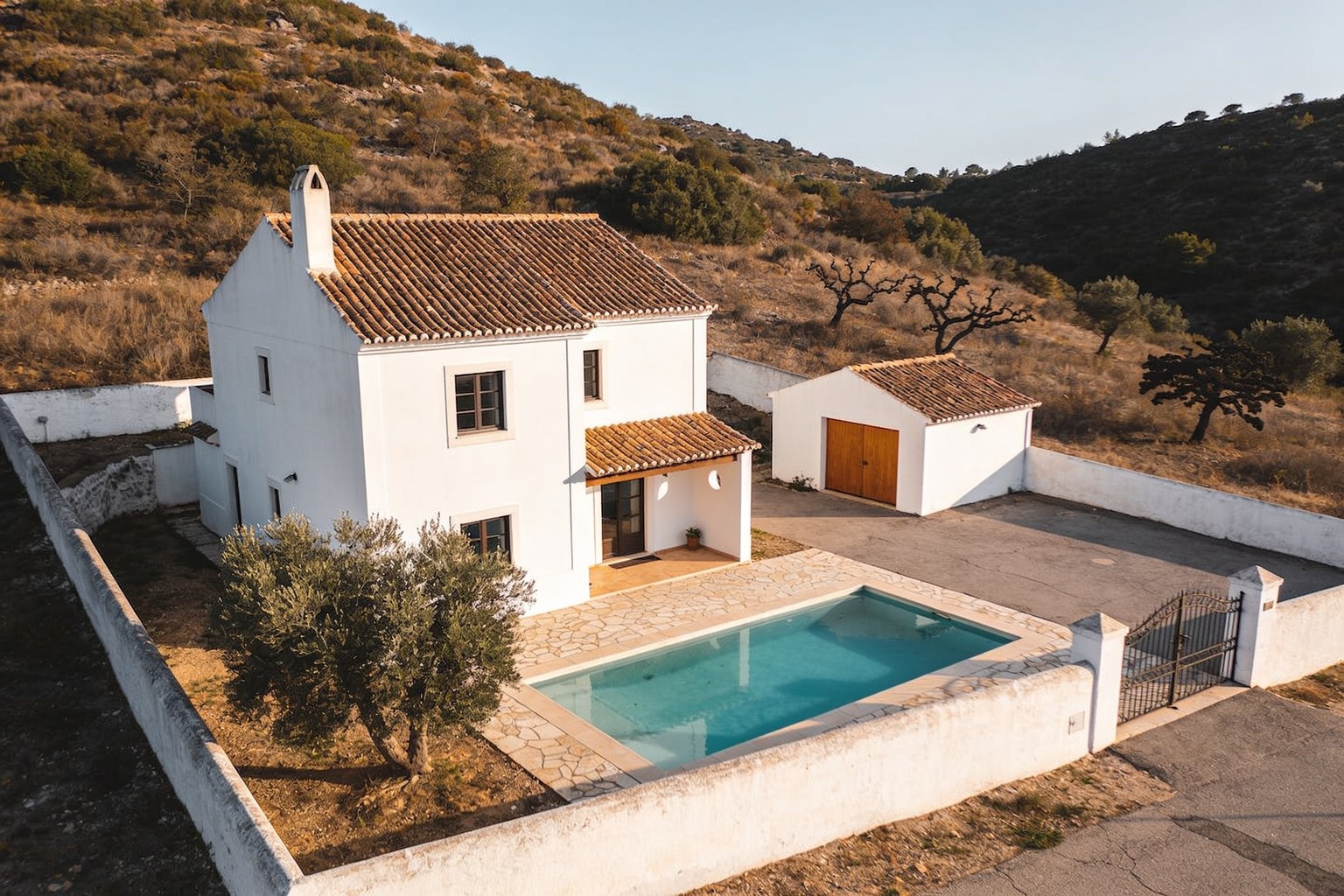
- Outbuildings and pool: garage, storeroom, guest house, workshop, covered terrace. Fidelidade expressly counts storerooms, garages, water tanks and pools, with their permanently built covers, as part of the building.
- Walls, gates, garden: at Fidelidade, boundary walls, retaining walls and gates are only included if they are listed in the policy with their value. Gardens and paths are only insured there under a separate cover. How pools and liability fit together is explained in our article on pools in Portugal.
- Later improvements: extension, new kitchen, loft conversion. At Fidelidade, permanent improvements made by the owner (benfeitorias) count as part of the building, but they must be included in the sum.
- Solar installations: solar thermal collectors for hot water count as part of the building at Fidelidade. A photovoltaic system is a separate item there: unless agreed otherwise it is replaced at new value less a deduction for age and wear, and it is not index-linked. Declare it separately with its value. More in our article on solar panels in Portugal.
The building sum does not include the land, furniture and other movable items (they belong under contents) or vehicles. Also ask whether demolition, debris removal and architect’s fees after a total loss are paid from within the sum or insured as a separate amount. If they come out of the sum, allow for them in your calculation. For fees of architects, engineers and surveyors needed after a loss for assessment, estimates and design, Fidelidade offers a separate cover (Honorários de Técnicos), which applies if it has been taken out, up to the amount in the specific conditions. It does not pay for preparing your claim against the insurer.
Flats in an apartment building
For a flat in a condominium, the sum covers not only the flat itself but also your share of the common parts: stairwell, roof, façade, lift, shared garage. Fidelidade states this expressly in clause 18. After a loss to the common parts, you receive the share that corresponds to your ownership share (permilagem).
Fire insurance is compulsory by law for every flat and for the common parts, and the condominium’s sum must be updated every year. How this fits with the obligation, the administrator and the bank is explained in our guide Is home insurance mandatory in Portugal?. If the condominium has its own policy for the building, find out what it covers before setting your own sum. Otherwise you may insure parts twice or leave a gap.
Underinsurance: how the insurer reduces a claim
The rule is in Article 134 of the insurance contract law: if the sum insured is below the value of the insured property, the insurer is only liable in the corresponding proportion, unless agreed otherwise. You bear the rest. In Portugal this is called the regra proporcional, and it applies to every claim, not only to a total loss.
Suppose a house in the Algarve is insured for €180,000, but rebuilding it would cost €240,000. The sum covers 75% of the value. After a water damage claim of €40,000, the insurer pays 75% of it, i.e. €30,000 (before any excess). The remaining €10,000 stays with the owner, even though the loss is far below the sum insured.
Some policies soften the rule. At Fidelidade, with agreed index-linking or a fixed annual increase of the sum, the proportional rule does not apply if the sum insured reaches at least 85% of the reconstruction cost or if the loss stays below an amount stated in the specific conditions (Condições Particulares). If the house in the example were insured for €210,000 (87.5%), the €40,000 would be paid in full there, provided all other conditions are met. Whether, and from what share, your insurer waives the reduction is set out in your conditions.
If the building and contents are insured in one contract with separate sums, each sum is assessed on its own (Fidelidade, clause 20). Under clause 21, however, Fidelidade spreads an excess in one item across underinsured items of the same policy, in line with the premium the excess generates; items insured on a first-loss basis are left out. Whether your policy has such an offsetting rule is set out in the conditions. What else matters after a loss, from the eight-day deadline to the evidence, is covered in our guide Home insurance claims in Portugal.
Overinsurance: premium without a return
A higher sum than necessary feels safe but brings nothing. The insurer pays at most the loss actually suffered (Article 128), at Fidelidade at most the reconstruction cost. This can happen when the sum matches the mortgage amount or the purchase price.
If you find that your sum is clearly too high, you can ask for the contract to be reduced. If you acted in good faith, the insurer must refund the excess premiums paid in the two years before your request, less a proportional share of acquisition costs (Article 132). A small margin above the calculated reconstruction cost is sensible, though, because building prices can rise between two updates and a tightly calculated sum then quickly falls below the value. If the bank required a specific sum for the mortgage, check with it what it will accept before making a change.
Annual index-linking
Building costs change. Article 135 of the insurance contract law therefore provides that, for insurance of residential property, the insured value is updated automatically in line with the index published for this purpose by the insurance regulator ASF, unless the contract provides otherwise. The ASF publishes three values every quarter: for buildings (Índice de Edifícios, IE), for contents (IRH) and for both together (IRHE).
The index can move significantly. For policies starting or renewing in the second quarter of 2023, the buildings index was 13.77% above the previous year’s value, according to a report by ECO Seguros. Anyone insured without updating in such a year was quickly below the value of the house, and even a small claim was reduced proportionally.
At Fidelidade, the specific conditions (Condições Particulares) state whether the sum rises with the index (Atualização Indexada de Capitais) or by a fixed percentage (Atualização Convencionada). You will find the updated sum on the premium receipt. At Fidelidade you can waive the index-linking by giving 60 days’ notice before renewal. That only makes sense if you recalculate the sum yourself regularly.
Two points give you extra protection and two remain your job:
- The insurer’s duty to inform: at the start and at every renewal, it must tell you about the automatic update, the sum applicable to a total loss and the update criteria. If it does not, it cannot apply underinsurance proportionally against you to that extent (Article 135(3)).
- Condominium: in a condominium, the annual update of the fire insurance is mandatory. If the owners’ meeting does not decide on an amount, the administrator updates it according to the regulator’s index.
- Report alterations: the index reflects a nationwide trend, not your house. Fidelidade states expressly that index-linking does not release the policyholder from adjusting the sum after improvements or new elements.
- Regional differences: the index applies nationwide. The ASF itself points out that policyholders must take regional variations and changes to their building into account.
What about contents?
Furniture, clothing, appliances and other movable items have their own sum (recheio). At Fidelidade, contents are generally replaced at new value, i.e. what equivalent new items cost. Exceptions include furniture in a furnished rented property, which is depreciated by condition and use, and outdated appliances, for which the market value is paid. Jewellery, art and other special items (objetos especiais) that are not listed individually with their value in the policy are only covered at Fidelidade up to the maximum amounts in the specific conditions.
The reduction for underinsurance applies to contents too. A list with photos and receipts helps twice: when setting the sum and after a loss. If you only use a holiday home part of the year, our guide Holiday home insurance in Portugal covers vacancy and letting.
Five mistakes with the sum insured
Frequently asked questions
How do I calculate the reconstruction cost of my house in Portugal?
Gross area from the Caderneta Predial times a price per square metre, plus outbuildings and outdoor elements. For the price per square metre you can use the zone values of the intermediaries’ association APROSE, between €732.53 and €924.95 in 2025, or the insurers’ freely accessible SCRIM simulator, which takes construction and finish into account and came out considerably higher in one worked example. For unusual houses, a professional’s estimate helps.
Do I have to insure the purchase price?
No. You insure what it costs to rebuild the building, without the land. The purchase price includes land and location and can be considerably higher or lower. If the bank required a specific sum, check with it whether it accepts the calculated reconstruction cost.
What happens if my home is underinsured?
Under Article 134 of Decree-Law 72/2008, the insurer pays only in the proportion of the sum insured to the actual value, unless the policy says otherwise. If a house is insured for 75% of its reconstruction value, a €40,000 claim brings you only €30,000. At Fidelidade there is no reduction with an agreed updating clause if the sum reaches at least 85%.
Is it worth insuring my house for more?
Only with a small margin. The insurer pays at most the actual loss; a much higher sum only costs more premium. You can have an inflated sum reduced and, if you acted in good faith, reclaim the excess premiums of the last two years.
Is my sum insured updated automatically?
For residential buildings, yes, unless the contract provides otherwise: in line with the index the insurance regulator ASF publishes every quarter (Article 135 of Decree-Law 72/2008). The new sum is shown on the premium receipt. Renovations and new elements are not captured by the index; you must report them yourself.
Are the common parts included in the sum for my flat?
Yes, your share of them, at least under Fidelidade’s conditions. The stairwell, roof, façade or lift count with the share that corresponds to your ownership share. Check what the condominium’s policy already covers so that nothing is insured twice or not at all.
Is the tax value on the Caderneta Predial the right sum insured?
No. The valor patrimonial tributário is used for the property tax IMI and follows its own formulas. From the Caderneta Predial you need the gross areas; you calculate the value for insurance using prices per square metre or an estimate.
How often should I check the sum?
After every renovation, after building a pool or outbuilding, and otherwise every few years, even if the sum rises with the index. The index applies nationwide and takes account neither of regional prices nor of changes to your house.
Our advice as an independent broker
Set aside half an hour once: get the Caderneta Predial, read off the gross areas, list outbuildings and outdoor elements, run the figures through the simulator and the zone table, and put the result next to the sum in your policy. If your sum is clearly lower, have it increased before anything happens. If it is far higher, have it reduced. And check whether an updating clause is agreed and from what share your insurer waives the reduction.
As an independent broker, we recalculate the sum with you, compare the conditions of several insurers, look closely at the updating clause and the reduction rules, and explain everything in English. For an overview of home insurance, see our page House insurance in Portugal.
Have your sum insured checked and request a quote
Last updated: 2 November 2026. This article reflects the information available on that date and does not replace legal or insurance advice in individual cases. Sources: Articles 128 and 130 to 135 of Decree-Law 72/2008 on insurance contracts, ASF Regulatory Standard 5/2022-R on the indices for fire and natural hazards insurance, Article 5 of Decree-Law 268/94 on condominiums, Fidelidade’s general and special conditions (Condições Gerais and Especiais) for the home insurance “Fidelidade Casa Mais” (September 2026), APROSE’s square-metre values for 2025 and the SCRIM simulator worked example as presented by the mutual association Montepio, and the ECO Seguros report of 25 January 2023 on the ASF buildings index.